
Vaginal rejuvenation is not one treatment. The right approach starts with understanding the actual concern.
“Vaginal rejuvenation” has become one of those broad wellness terms that can mean almost anything depending on who is using it. Somewhere between social media marketing and celebrity headlines, the conversation has become both oversimplified and oddly taboo.
The reality is more nuanced and far more practical.
Changes after childbirth, aging, menopause, hormonal shifts, or simply time can affect comfort, pelvic support, intimacy, tissue quality, and bladder control. These concerns are common, and they are not purely cosmetic. Some are functional. Some are physical. Some affect confidence. Often, they overlap.
That is why the most useful question is not, “Which vaginal rejuvenation treatment should I get?” It is, “What is actually causing the concern I am experiencing?”
The goal is not to chase trends or create a standardized aesthetic. It's to help women feel comfortable, functional, and confident in their own bodies.
First: “Vaginal Rejuvenation” Is Not One Procedure
The term is often used as if it describes a single treatment. It does not. A patient concerned about urinary leakage may need a completely different evaluation and treatment plan than someone experiencing menopausal dryness, pelvic floor tension, stretched labial tissue, or changes in sensation.
Dryness or Irritation
Hormonal changes and tissue quality may be part of the conversation.
Leakage or Pelvic Pressure
Pelvic floor function and support deserve careful evaluation.
Pain or Muscle Tension
Overactive muscles or pelvic floor dysfunction may contribute.
Labial Discomfort
Enlarged or stretched tissue may create both functional and cosmetic concerns.
I do not think of vaginal rejuvenation as a menu where every patient chooses from the same list. The starting point is the concern itself: dryness, pain, leakage, laxity, tissue changes, appearance, or something else. Once we understand the problem, we can discuss whether treatment is appropriate and which option makes sense.
Sometimes the Best Treatment Is Not a Procedure
One of the biggest problems with the way vaginal rejuvenation is marketed is the assumption that every concern needs a device, injection, or surgery. That simply is not true.
Pelvic Floor Physical Therapy
Non-surgical · Functional carePelvic floor physical therapy can be incredibly helpful for concerns involving pressure, discomfort, urinary leakage, pelvic floor weakness, or pelvic floor dysfunction. It may also help patients who have muscles that are too tight rather than too weak, an important distinction because strengthening exercises are not the answer for every pelvic floor problem.
A trained pelvic floor physical therapist can evaluate muscle coordination, strength, tension, and function and build a treatment plan around the specific issue.
Vaginal Estrogen
Prescription therapy · Hormonal supportAfter menopause, lower estrogen levels can contribute to dryness, irritation, tissue fragility, and discomfort. For appropriate patients, local vaginal estrogen may meaningfully improve tissue quality, hydration, and comfort.
This is a good example of why the diagnosis matters. If hormonal tissue changes are driving the symptoms, treating those changes directly may be more useful than choosing a procedure simply because it is marketed as “rejuvenation.”
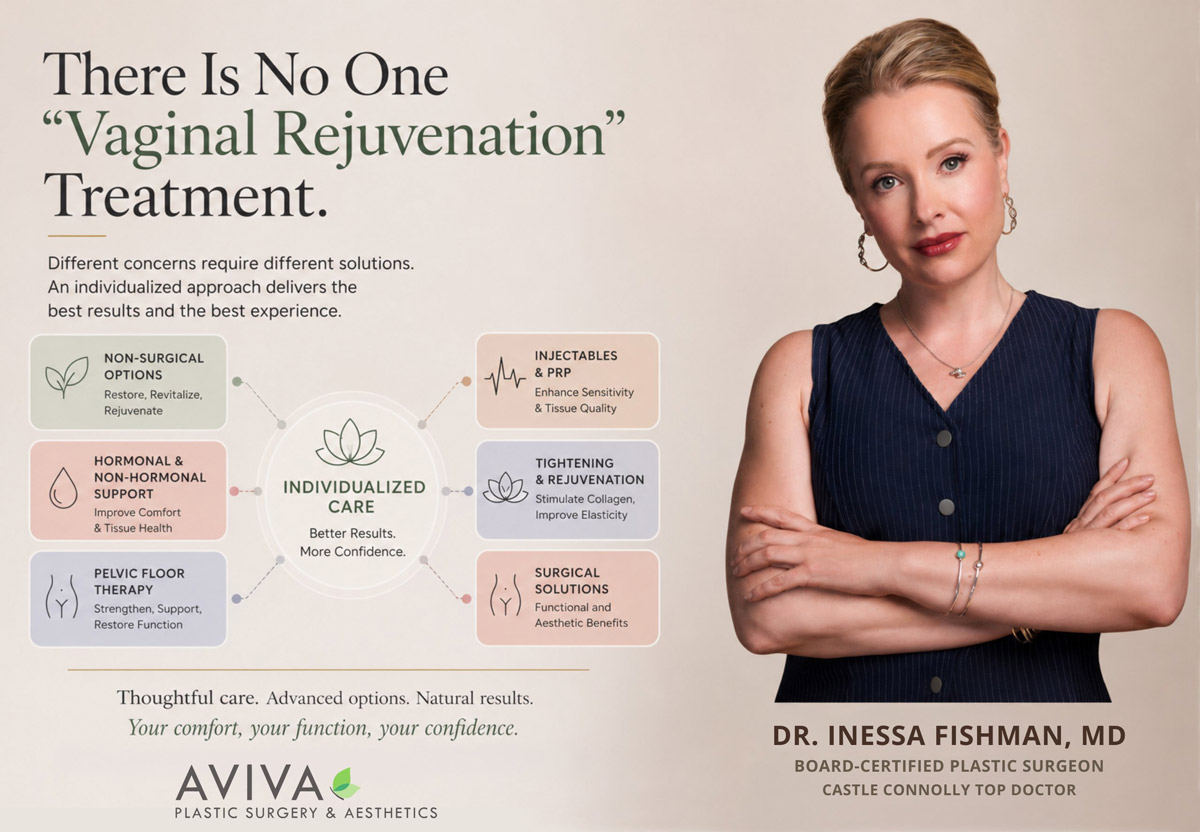
The right treatment depends on the concern and sometimes the right answer is a combination of approaches.
Minimally Invasive Options for Selected Patients
There are also a growing number of minimally invasive treatments that may help carefully selected patients. These options are not interchangeable, and none is right for everyone.
PRP
Regenerative approachPlatelet-rich plasma, or PRP, uses a concentrated portion of the patient's own blood containing platelets and growth factors. In intimate wellness care, PRP may be discussed as an option to support tissue health and sensitivity in selected patients.
It is important to have realistic expectations. PRP is not a universal solution for every concern involving sensation, intimacy, or tissue quality, and the evidence and expected benefit depend on the specific indication.
Carefully Placed Filler
Injectable treatmentIn selected patients, carefully placed filler may be used in the G-spot area to add fullness and support. This is a highly individualized treatment and should never be approached as a guaranteed way to change sexual response.
Anatomy, goals, and expectations all matter. The conversation should be specific about what filler can realistically change and what it cannot.
Botox for Overactive Muscles
Targeted muscle relaxationBotox may help relax overactive pelvic floor or clitoral muscles that contribute to pain or tension in certain patients. This is very different from using Botox for wrinkles: the goal is targeted relaxation of muscles that may be contributing to a functional problem.
Because pain can have many causes, careful evaluation is essential before deciding whether muscle overactivity is actually part of the problem.
Votiva Radiofrequency Treatment
Energy-based treatment · Little downtimeVotiva is a radiofrequency treatment designed to support collagen remodeling, circulation, hydration, and tissue tightening with little downtime. For selected patients, it may be part of a treatment plan for tissue changes involving comfort, laxity, or intimate wellness concerns.
As with any energy-based treatment, the recommendation should be based on the patient's anatomy, symptoms, goals, and medical history not simply on the availability of the device.
When Labiaplasty Is About More Than Appearance
For women bothered by enlarged, elongated, or stretched labia, labiaplasty can serve both cosmetic and functional purposes.
Some women simply dislike the appearance of the labia. Others experience:
- Pulling or twisting of the tissue
- Discomfort in fitted clothing
- Irritation during exercise or cycling
- Pain or discomfort with intimacy
- Self-consciousness that affects confidence
Both cosmetic and functional reasons are legitimate reasons to explore treatment. The important thing is that the decision belongs to the patient not to a trend, a partner, or an imagined standard of what anatomy is “supposed” to look like.
There is no single “normal” appearance for the vulva and labia. Natural anatomy varies widely. Treatment should address a patient's own symptoms, concerns, and goals but not to create a standardized aesthetic.
Which Treatment Addresses Which Concern?
This is not a diagnostic chart, but it helps illustrate why one treatment cannot reasonably be called the answer to every intimate wellness concern.
The Best Approach Is Individualized
Not every patient needs treatment, and no single treatment is right for everyone. Sometimes one concern has several contributing factors. Sometimes the best plan combines approaches. Sometimes the most appropriate recommendation is reassurance, observation, physical therapy, or medical treatment rather than a procedure.
A thoughtful consultation should focus on symptoms, anatomy, medical history, goals, and expectations. It should also create room for questions that patients may have felt embarrassed or uncomfortable asking elsewhere.
These conversations should be practical, respectful, and free of shame. My goal is not to convince every patient that she needs treatment. It is to understand what is bothering her, explain the options clearly, and help her make an informed decision about her own body.

Preguntas Frecuentes
Not every patient needs treatment, and no single treatment is right for everyone.
Start With a Conversation, Not a Buzzword
If intimate changes are affecting your comfort, function, confidence, or quality of life, a personalized consultation can help clarify what is happening and which options may be worth considering.
Agendar una ConsultaThis post is for informational purposes only and does not constitute medical advice. Individual results vary. All surgical decisions are made on an individualized basis following a thorough in-person consultation with Dr. Fishman.
 English