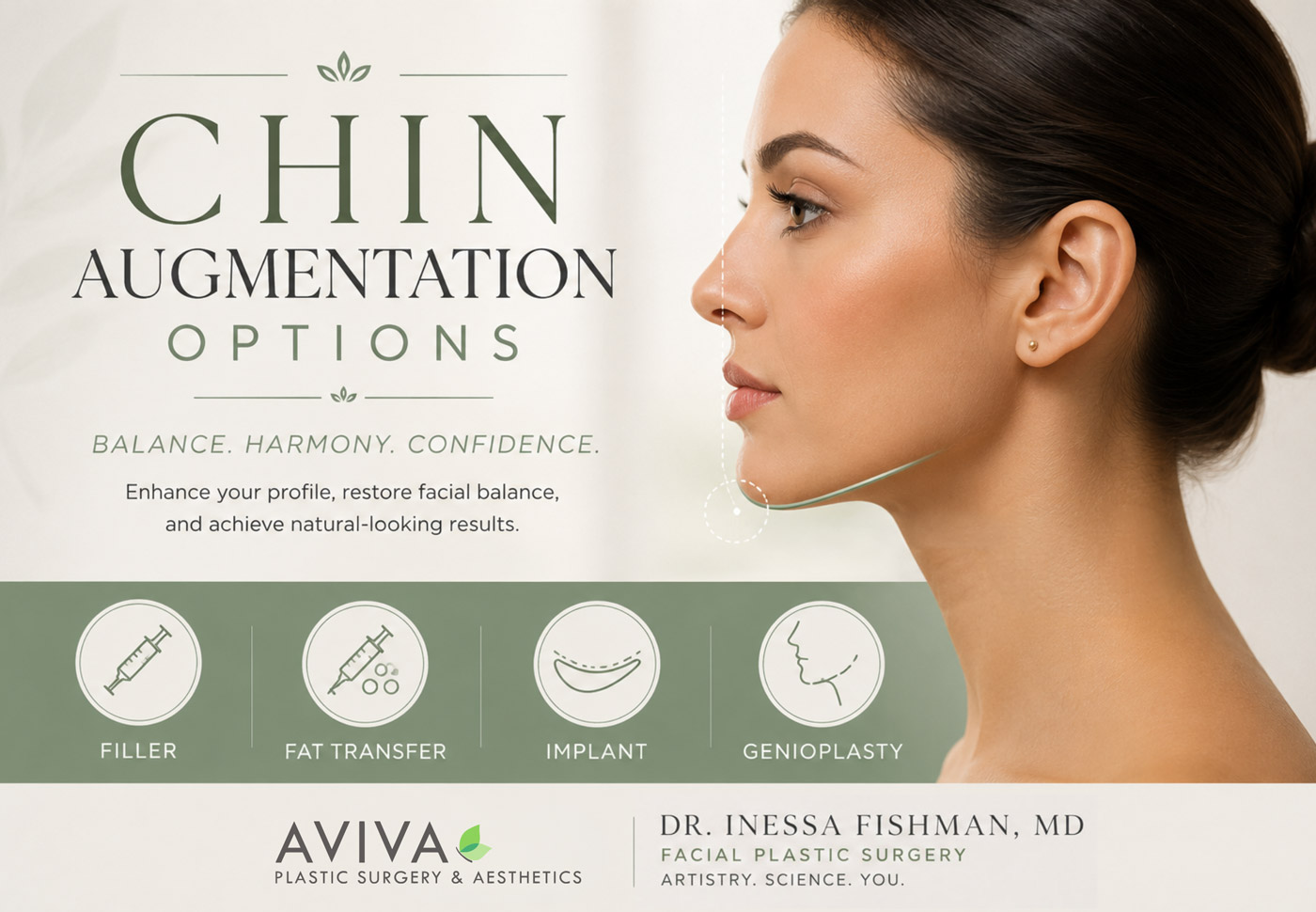
Chin augmentation options: Balance. Harmony. Confidence.
The chin is one of those facial features that quietly does a lot of work. When it's well-proportioned, you don't notice it and everything just looks balanced. When it's under-projected or undefined, it can affect how the entire lower face, the jawline, the neck, and even the nose read in photographs and in person.
Patients often come to me asking about rhinoplasty when what's really bothering them is chin projection. Or they're frustrated with their profile and can't quite identify why. In many of these cases, the chin is part of the answer.
The good news is that there are several options for chin enhancement ranging from a quick in-office filler treatment to surgical implants to bone repositioning surgery and the right choice depends entirely on your anatomy, your goals, and whether you want something temporary or permanent.
Improving chin projection can often enhance the entire lower face without changing your natural appearance.
Why the Chin Matters More Than You Think
The chin anchors the lower third of the face. Its position and projection affect:
- Facial profile: how balanced the side view looks
- Jawline definition and sharpness
- Neck contour: a weak chin can make the neck appear shorter or less defined
- Overall facial symmetry and harmony
- How the nose appears in proportion: a recessed chin can make the nose look larger than it is
I frequently see patients who come in thinking they need a nose job when what's actually disrupting their facial balance is chin projection. Before recommending any procedure, I evaluate the full lower face, chin, jawline, neck to understand where the imbalance is actually coming from. Sometimes it's the chin. Sometimes it's both. The right answer starts with an honest assessment of the whole picture.
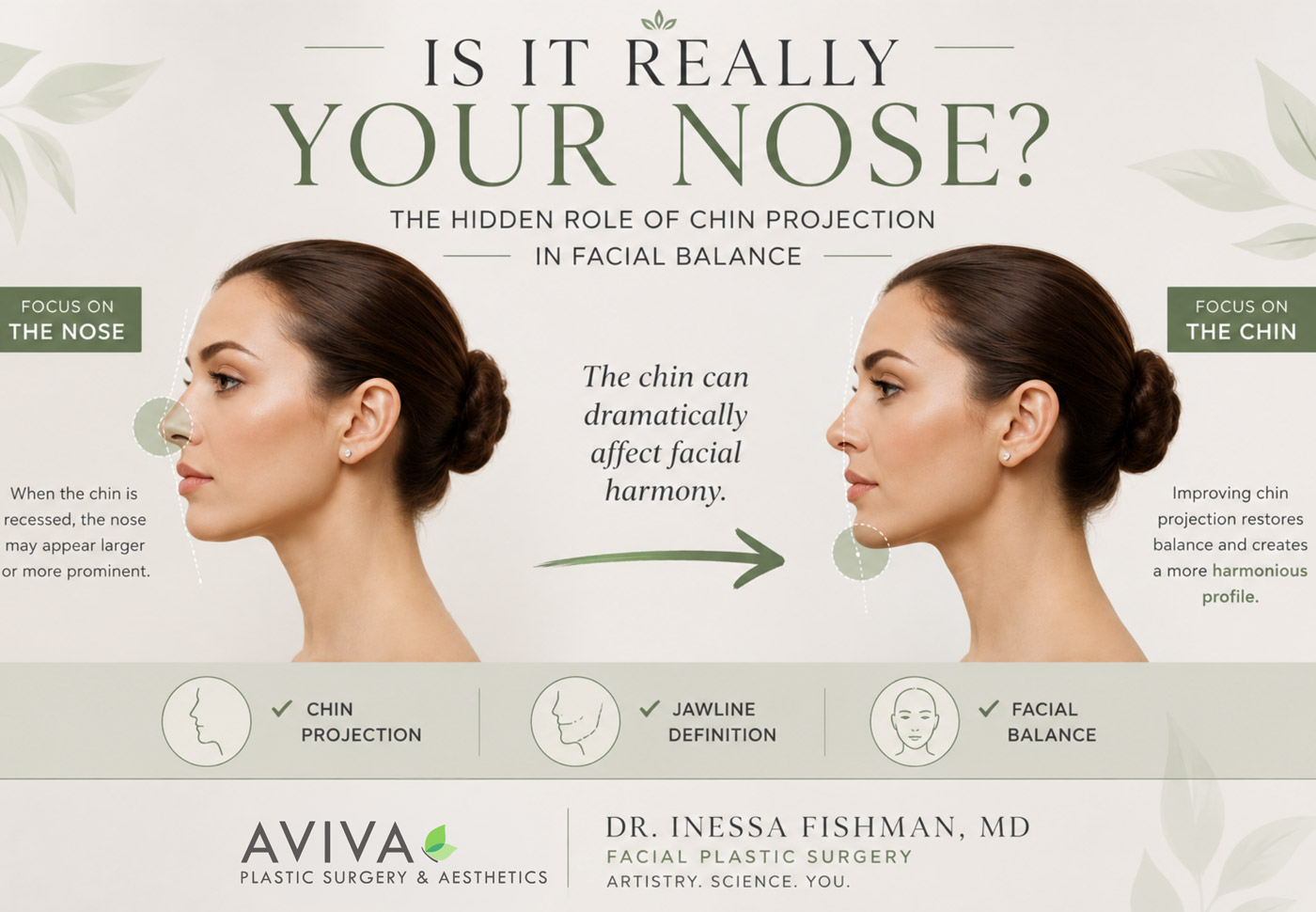
When the chin is recessed, the nose may appear larger or more prominent. Improving chin projection restores balance and creates a more harmonious profile.
Who May Benefit From This Procedure?
You may be a good candidate if you notice one or more of the following:
In many cases, the issue is not volume, it is position. Patients who have tried filler repeatedly and still feel their lower lip looks thin or recessed are often describing a structural concern, not a volume concern. More filler won't fix a positioning problem. Surgery can.
The Four Chin Augmentation Options
At Aviva Plastic Surgery, I offer several approaches to chin enhancement depending on your goals, anatomy, and whether you prefer a temporary or permanent result. Here is an honest breakdown of each.
Chin filler is one of the most commonly performed treatments in my practice for patients who want to explore chin enhancement without committing to surgery. Using products like Restylane o Radiesse, I can add structure, projection, and definition to the chin area in a single in-office visit.
What I appreciate most about this option is its flexibility. It gives patients a realistic preview of what chin enhancement can do for their face before deciding whether they want something permanent. Results are immediate, adjustable, and completely reversible.
Chin filler is one of my favorite non-surgical tools because the results-to-effort ratio is so high. A small amount of product in exactly the right place can significantly improve facial balance. It's also a great "test run" many patients who try filler first come back wanting a permanent solution once they see what the improvement looks like.
Fat grafting uses your own body fat taken from another area, purified, and carefully injected to add volume and contour to the chin. Because it uses your own tissue, results feel completely natural and soft.
This is a good option for patients who want a more permanent but natural enhancement without an implant, or who are already having another procedure that involves fat harvesting such as a facelift or liposuction.
Chin implants are my go-to recommendation for patients who want a predictable, permanent, structural improvement in chin projection. At Aviva Plastic Surgery, I use medical-grade silicone implants with a soft, natural feel similar in quality to the implants used in breast augmentation.
The procedure is performed with local anesthesia and oral sedation or IV sedation depending on the patient's preference, and the implant is placed through a small, discreet incision. The result is reliable, long-lasting chin definition that holds up beautifully over time.
Chin implants are one of the most satisfying procedures I perform, the improvement in facial balance is often dramatic, but because it's structural rather than volumetric, it never looks overdone. Patients often tell me it's the single change that finally made everything else look right.
A sliding genioplasty is a more advanced procedure that involves cutting and repositioning the chin bone itself, moving it forward, downward, or in multiple directions simultaneously. It is performed by an Oral and Maxillofacial Surgeon, not a plastic surgeon.
This option is typically reserved for patients with more complex skeletal imbalances, severe chin recession, asymmetry, or cases where functional and structural correction are both needed.
We do not perform sliding genioplasty at Aviva Plastic Surgery. However, for patients who need this level of correction, I refer to a trusted specialist:
Dr. Loetscher: Oral and Maxillofacial Surgeon
(770) 664-5550
Comparing Your Options at a Glance
| Option | Type | Duration | Downtime | Best For |
|---|---|---|---|---|
| Dermal Filler | Non-surgical | 12–18 months | Minimal | Subtle enhancement, trying before surgery |
| Injerto de Grasa y | Quirúrgico | Long-lasting | Moderate | Natural result, no synthetic materials |
| Chin Implant | Quirúrgico | Permanent | 7–10 days | Predictable, lasting structural improvement |
| Sliding Genioplasty | Surgical (specialist) | Permanent | 2–4 weeks | Complex skeletal correction (referred out) |
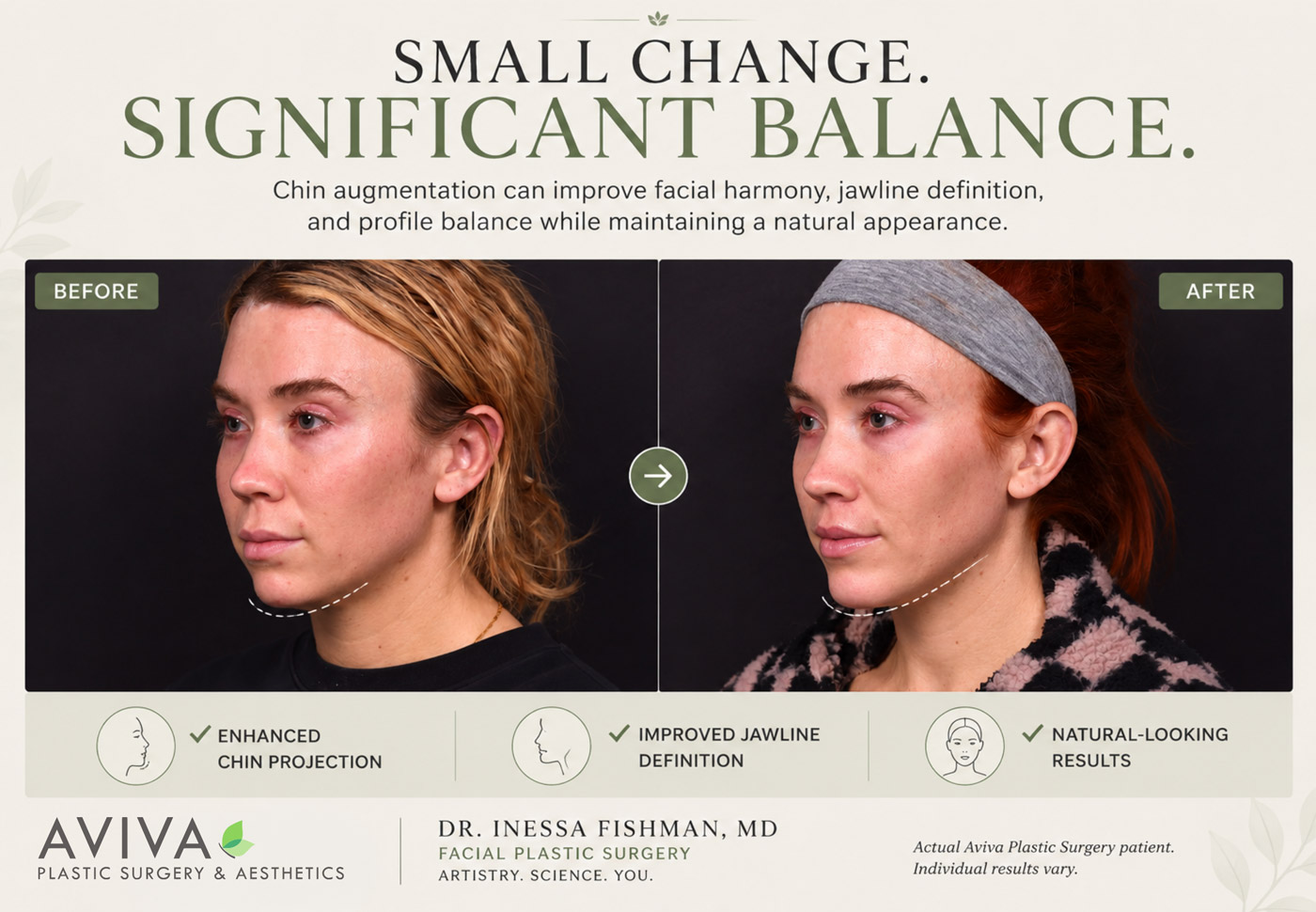
Before & After: Chin Augmentation by Dr. Inessa Fishman, MD · Actual Aviva Plastic Surgery patient · Individual results vary
Often Combined for Best Results
The chin rarely exists in isolation when we're evaluating facial balance. Depending on your goals and anatomy, chin augmentation is frequently combined with:
Rinoplastia
Chin projection directly affects how the nose appears in profile. Addressing both together often creates the most harmonious result.
Neck Lift / Facelift
Chin implants are frequently combined with neck or lower face procedures for a comprehensive lower face rejuvenation.
Jawline Filler
For patients choosing the non-surgical route, chin filler combined with jawline contouring creates a more complete lower face result.
Chin augmentation is not about creating a new face. It's about restoring or establishing balance, so that every feature reads the way it should. When I evaluate a patient for chin enhancement, I'm always looking at the whole lower face, not just the chin in isolation. The best results come from treating the face as a system.
Recovery: What to Expect?
Recovery varies depending on which option you choose. Here's a general overview:
Mild swelling or bruising possible, resolves quickly. Most patients return to normal activity immediately or the next day.
Swelling, tightness, and tenderness around the chin. Soft food diet recommended. Most patients are comfortable at home.
Most patients feel comfortable returning to social settings. Visible swelling continues to resolve over the following weeks.
Final results become visible as swelling fully resolves and the implant settles into position. Full activity typically resumes.
Preguntas Frecuentes
Chin augmentation is not about creating a new face.
It's about helping your features work together the way they were meant to.
Natural results that enhance your confidence without looking overdone.
Schedule a Consultation in Atlanta
If you're noticing that your chin affects your facial balance or profile or if you're simply curious about your options, a consultation is the right place to start. Every face is different, and every plan should be built around yours.
Agendar una ConsultaThis post is for informational purposes only and does not constitute medical advice. Individual results vary. All surgical decisions are made on an individualized basis following a thorough in-person consultation with Dr. Fishman.