
Weight loss can change facial volume, skin laxity, and the balance of the face and neck. The right treatment depends on what has actually changed.
GLP-1 medications have changed the weight-loss conversation for many of my patients in Atlanta. They can support meaningful weight loss and real improvements in health, but as the body changes, the face may change too.
Some patients notice that their cheeks look flatter or more hollow. Others see looser skin around the jawline or neck. For some, the change is subtle. For others, it can make the face look more tired or older than they feel, even when they are very happy with the weight they have lost.
These changes are sometimes described online as "Ozempic face," but that shorthand can be misleading. Facial changes are associated with weight loss itself, not one particular medication, and they do not happen to everyone.
After significant weight loss, facial rejuvenation is not about replacing everything that was lost. It is about understanding what changed.
Why Can the Face Change After GLP-1 Weight Loss?
Fat contributes to the shape and support of the cheeks, temples, under-eye area, and other parts of the face. When someone loses a significant amount of weight, some facial fat may be lost along with fat elsewhere in the body.
As facial volume decreases, the cheeks may look flatter and hollows or lines that were previously less noticeable may become easier to see. At the same time, the skin does not always contract at the same pace as the underlying volume changes. This can leave laxity along the lower face, jawline, or neck.
How noticeable these changes become depends on several factors, including age, skin quality, genetics, the amount of weight lost, and the individual's facial anatomy.
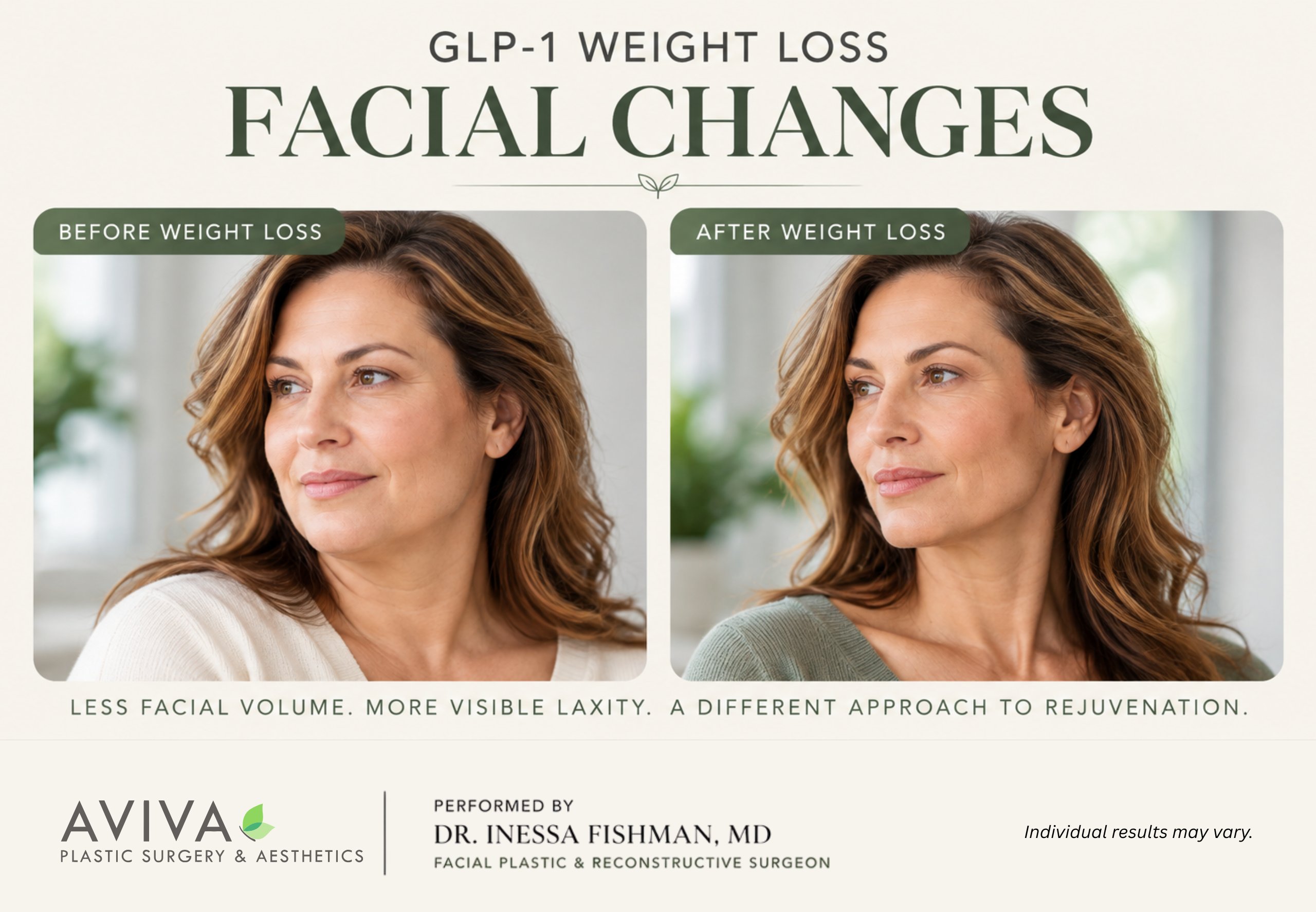
Weight loss does not affect every face in the same way. One patient may primarily lose cheek volume, while another develops laxity along the jawline and neck. Many patients have a combination of changes. The treatment plan should follow the anatomy, not the trend.
Volume Loss, Loose Skin, or Both?
This distinction matters because facial rejuvenation is not one treatment. A treatment that restores volume does not necessarily tighten loose skin, and a procedure that lifts lax tissue does not automatically replace lost facial volume.
Volume Loss
Flatter cheeks, temple hollowing, deeper facial shadows, or a more deflated appearance may point toward lost facial volume.
Skin Laxity
Jowling, a softer jawline, or loose tissue through the lower face and neck may reflect laxity rather than a lack of volume.
Combination Changes
Many patients experience both. In those cases, combining carefully selected treatments may create the most balanced result.
How Does Weight Loss Change the Facial Rejuvenation Plan?
For my Atlanta patients, the starting point is a careful assessment of the face as a whole. We look at where volume has been lost, whether skin and deeper tissues have become lax, how the neck has changed, and what the patient actually wants to improve.
Depending on those findings, treatment may include:
- Dermal fillers to restore selected areas of facial volume when a nonsurgical approach is appropriate.
- Facial fat grafting to restore volume using the patient's own fat in carefully chosen areas.
- Facelift surgery when jowling and laxity through the lower face are the dominant concerns.
- Neck lift surgery when loose skin, tissue laxity, or loss of definition beneath the jaw and through the neck are more significant.
- Skin-focused treatments when texture, tone, or skin quality are part of the concern.
Some patients benefit from a combination approach. Others need only one focused treatment. And some patients are pleased with how their face looks after weight loss and need no treatment at all.

When Does a Facelift or Neck Lift Make More Sense?
If the main change after weight loss is loose tissue rather than isolated volume loss, adding more filler may not address the real problem. Patients with jowling, laxity along the jawline, or loose neck skin may be better candidates for surgical lifting.
A facelift addresses laxity and descent through the lower face, while a neck lift is designed around concerns below the jawline and through the neck. In patients with changes in both areas, face and neck lifting may be considered together. Dr. Fishman also frequently combines lifting with facial fat grafting when restoring selected areas of volume will improve overall balance.
More volume is not always the answer. If the underlying issue is tissue laxity, repeatedly adding filler can work against a natural result. The important question is not "What treatment is popular after GLP-1 weight loss?" It is "What changed in this particular face?"
Does the Timing of Facial Surgery Matter?
It can. If you are still actively losing weight, your face may continue to change. That can influence both the timing of a procedure and the treatment plan itself.
There is no single amount of time that is right for every patient. The decision depends on the pace of weight loss, whether your weight is continuing to change, your health, your facial anatomy, and the procedure being considered.
For patients considering surgery, the conversation also goes beyond appearance. GLP-1 medications can affect appetite and gastrointestinal symptoms, and the surgical team needs to know which medication you take, your dosing schedule, any recent dose changes, and any symptoms you are experiencing. This information guides individualized anesthesia and perioperative planning.
Do not stop a prescribed GLP-1 medication on your own before surgery. Your surgeon, anesthesia team, and prescribing clinician should determine the appropriate plan for you together.
A More Personal Approach to Facial Rejuvenation

GLP-1 medications have changed the questions patients bring into facial plastic surgery consultations, but they have not changed the basic principle behind thoughtful facial rejuvenation. Treatment should be based on anatomy, health, goals, and what will create a natural result for that individual patient.
For one person, that may mean restoring a small amount of lost volume. For another, it may mean addressing loose skin with a facelift or neck lift. For someone else, the best choice may be to wait until weight has stabilized, or to do nothing at all.
The goal is not to erase the evidence of weight loss. It is to help the face look balanced, healthy, and like you.
Frequently Asked Questions
The face should be treated as a whole, not as a collection of isolated problems.
Explore Facial Rejuvenation After Weight Loss in Atlanta
If weight loss has changed the way your face or neck looks, a consultation with Dr. Inessa Fishman can help clarify what you are seeing and whether treatment makes sense for you.
At Aviva Plastic Surgery & Aesthetics in Atlanta, Dr. Fishman offers surgical and nonsurgical facial rejuvenation with treatment plans built around each patient's anatomy, health, and goals.
This post is for informational purposes only and does not constitute medical advice. Individual results vary. Treatment recommendations, medication management, and surgical decisions are made on an individualized basis following consultation with the appropriate medical professionals.
 English